

Let's be real: AI voice agents used to sound like robots reading a script…and not a very good one. If you ever called a customer service line and felt your soul leave your body while a bot asked you to "please repeat your request," you're not alone.
But things have changed. Today's AI voice agents can actually hold real conversations, pick up on context, and respond to customers without making them want to hang up. For small businesses with lean teams, that's a big deal. It means you can extend your reach without hiring a small army.
The State of AI voice for SMBs
Two years ago, AI was a simple sales assistant. It pulled up data, suggested responses, and did the background work. Today, it can handle entire conversations and hand off ready-to-buy leads to the human sales rep to close the sale.
But not all AI tools are built the same. The market has split into two camps: platform apps like Synthflow that handle setup for you, and infrastructure providers like Bland AI and Vapi that provide the raw building blocks.
So which one is right for you?
It comes down to two things: how technical your team is, and how much control you actually need.
Top AI voice agents for small businesses
There's no shortage of AI voice agents out there, but not all of them are built with the same audience in mind.
We did the legwork and narrowed it down to the tools worth small businesses’ attention by putting each one through the same lens: what it does and who it's built for, what it gets right, where it falls short, and what it'll cost you.
Chloe
Website: https://www.close.com/chloe
What It Does / Who It's For
Chloe is an AI sales teammate built directly into Close CRM. She handles inbound lead calls end-to-end — answering instantly, running structured discovery based on your qualification criteria, booking meetings or routing to a live rep, and logging everything in your CRM in real time. She's built for small sales teams that need to respond to every lead fast without hiring more reps.
Key Features
- CRM-native: lives inside Close with no integration, syncing, or separate dashboard to manage
- Calls leads instantly, qualifies using your criteria, and books meetings or routes to a rep
- Logs the full conversation, outcome, and next steps in your CRM before the call ends
- Learns from your CRM context — leads, conversations, and outcomes — so every call gets smarter
Pros
- Zero speed-to-lead gap: picks up the moment a lead comes in
- No-code setup: define your qualification criteria, tone, and FAQs, then go
- Reps step into calls warm with full context — no cold intros or re-asking basics
- No new vendor to evaluate or integrate — she's already in your CRM
Cons
- English-only for now
- Currently in beta with limited access (full release planned for 2026)
Pricing
Free during early beta – join the beta waitlist here.
Synthflow
Website: https://synthflow.ai/
What It Does / Who It’s For
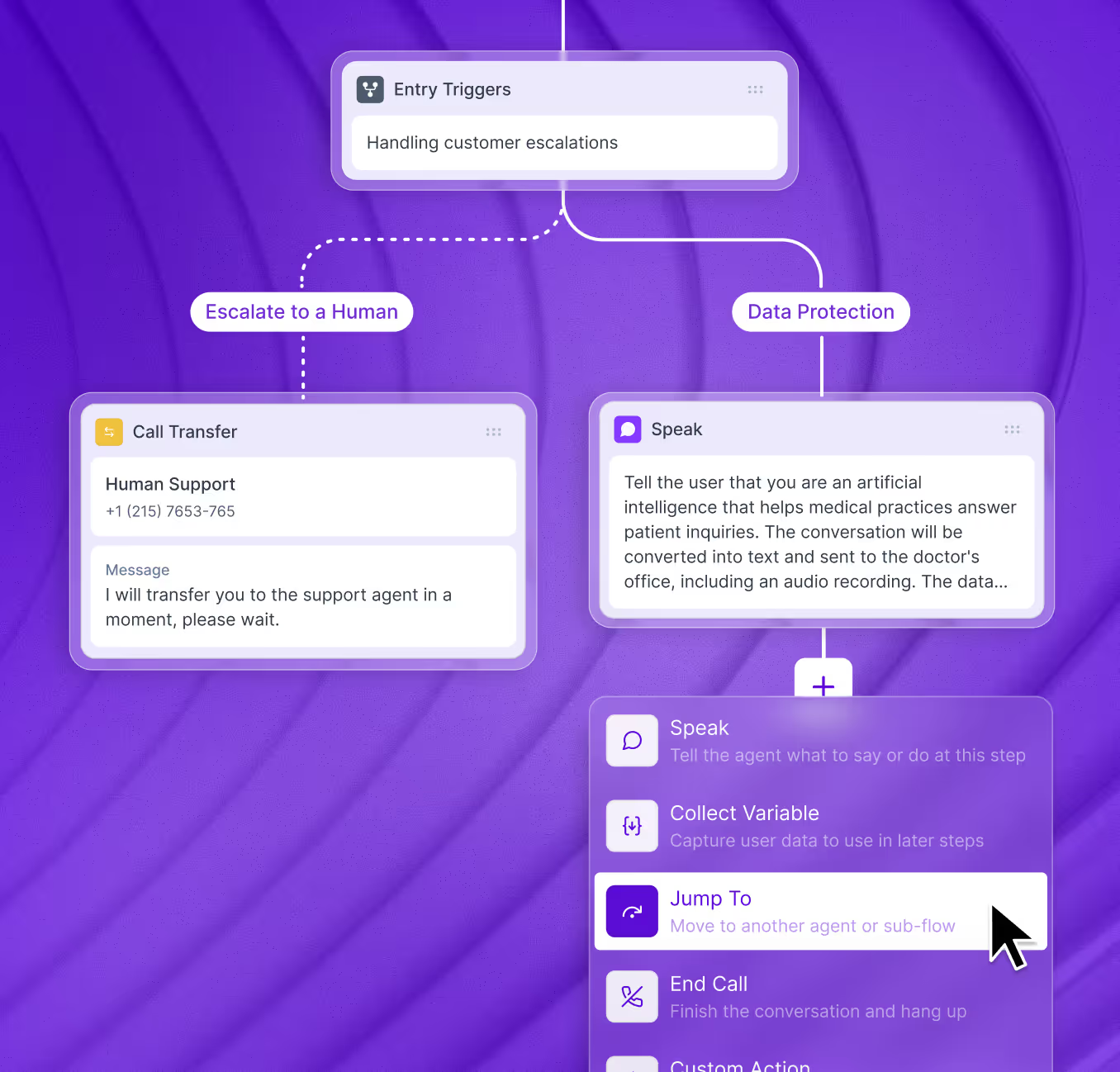
Synthflow is a no-code voice AI platform that automates phone calls using AI voice agents. It handles both inbound and outbound calls, including answering questions, routing based on context, booking appointments, detecting voicemails, and sending SMS follow-ups.
Key Features
- Integrates directly with telephony or any SIP-based providers, giving you complete control over routing, quality, and compliance
- Latency below 100 ms and uptime above 99.99%
- Multi-cloud redundancy, instant failover, and round-the-clock monitoring
- Synthflow’s infrastructure is certified across SOC 2, HIPAA, PCI DSS, and GDPR
Pros
- Advanced speech recognition, natural language understanding, and human-like voices
- Accurate, real-time conversations at scale
- Supports 30+ languages
- Integrates with CRMs and ERPs
Cons
- The costs can add up if you expect higher call volumes
- Fewer APIs and less control over features and plugins
Pricing
Synthflow offers two options:
- Pay As You Go: Free to start, then usage-based billing. Good for builders, pilots, and small deployments that aren't ready to commit. You get 5 concurrent calls, unlimited agents, API access, and standard integrations. Support is ticket-based.
- Enterprise: Custom pricing for teams handling 10,000-plus minutes a month. You get guaranteed 99.99% uptime, unlimited concurrent calls, white-label options, custom workflows, and dedicated onboarding and support.
Bland AI
Website: https://www.bland.ai/
What It Does / Who It’s For
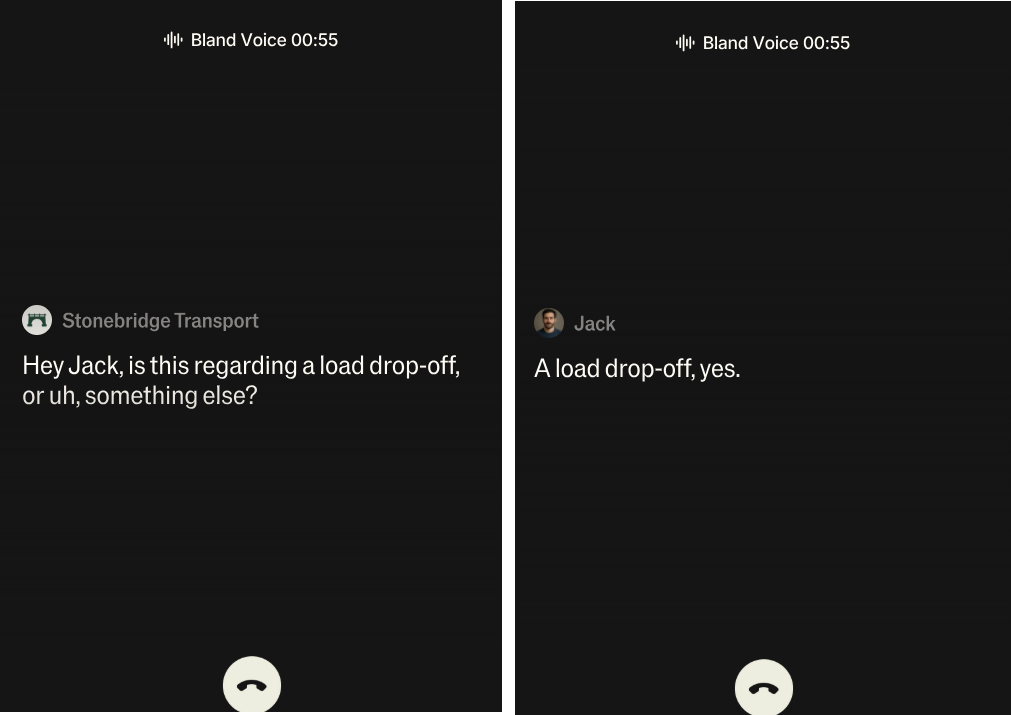
Bland AI is an infrastructure for voice automation. It handles inbound and outbound calls at scale with AI agents that sound human, respond quickly, and follow the logic you build into them.
Key Features
- API-first architecture with full programmatic control over call flows
- Visual Pathways builder for mapping conversation logic
- Ability to customize your models and voices, including training your models until they’re fine-tuned
- Omnichannel support across calls, chat, and SMS to create overall sales workflows
Pros
- You can clone any voice from a single short MP3 or audio clip
- Sound effect reproduction and multi-voice blending for creative customization
- Warm call transfers to live agents with full context on the conversation
- Live translate to pass information to agents in any language
Cons
- Integration requires some sophisticated engineering, as well as technical resources
- Not built for non-technical teams. The visual builder exists, but it's too limited for anything complex.
Pricing
Three self-serve plans, plus Enterprise. Free to start, but the per-minute rate is highest on the free tier.
- Start (Free): $0.14/min for connected, $0.05/min for transfers. Capped at 100 calls per day, 10 concurrent calls, 1 voice clone.
- Build ($299/month): $0.12/min connected, $0.04/min transfer. Up to 2,000 calls per day, 50 concurrent, 5 voice clones.
- Scale ($499/month): $0.11/min connected, $0.03/min transfer. Up to 5,000 calls per day, 100 concurrent, 15 voice clones.
- Enterprise (Custom pricing): Unlimited everything.
Retell AI
Website: https://www.retellai.com/
What It Does / Who It’s For
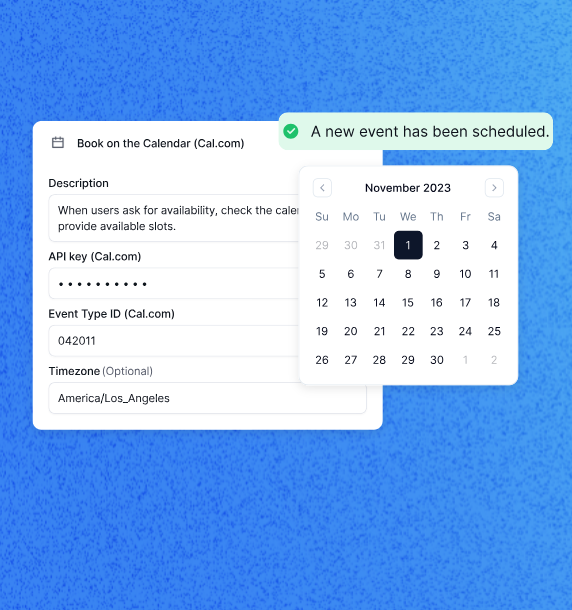
Retell AI is an LLM-based, humanlike, voice-first conversational AI platform. It handles inbound and outbound calls, books appointments, qualifies leads, and transfers to humans when needed. It sits in a sweet spot between Bland's raw infrastructure and Synthflow's no-code simplicity. In other words, it's technical enough for developers and approachable enough for non-technical teams to get going.
Key Features
- Smooth and fluent conversations with ~600ms latency
- No-code agent builders and APIs give you flexibility without the need for engineering
- Real-time voice conversations can take call intake off your hands
- SOC, HIPAA, GDPR support
Pros
- Natural, human-like conversations
- Fast setup with minimal configuration
- Handles edge cases and unexpected inputs
- Supports complex, multi-turn, and outbound use cases
Cons
- Handling unusual conversations may require more engineering on your part
Pricing
Retell AI has two plans:
- Pay As You Go: Free to start, self-serve, no commitment. Voice agents run at $0.07-plus per minute, chat agents at $0.002-plus per message. Comes with $10 in free credits, 20 concurrent calls, 10 free knowledge bases, and Discord and email support.
- Enterprise: Includes everything from Pay As You Go plus custom deployment, fully managed agent setup, higher concurrency limits, expanded knowledge base limits, early access to beta features, and dedicated Slack support.
Aircall AI Voice Agent
Website: https://aircall.io/
What It Does / Who It’s For
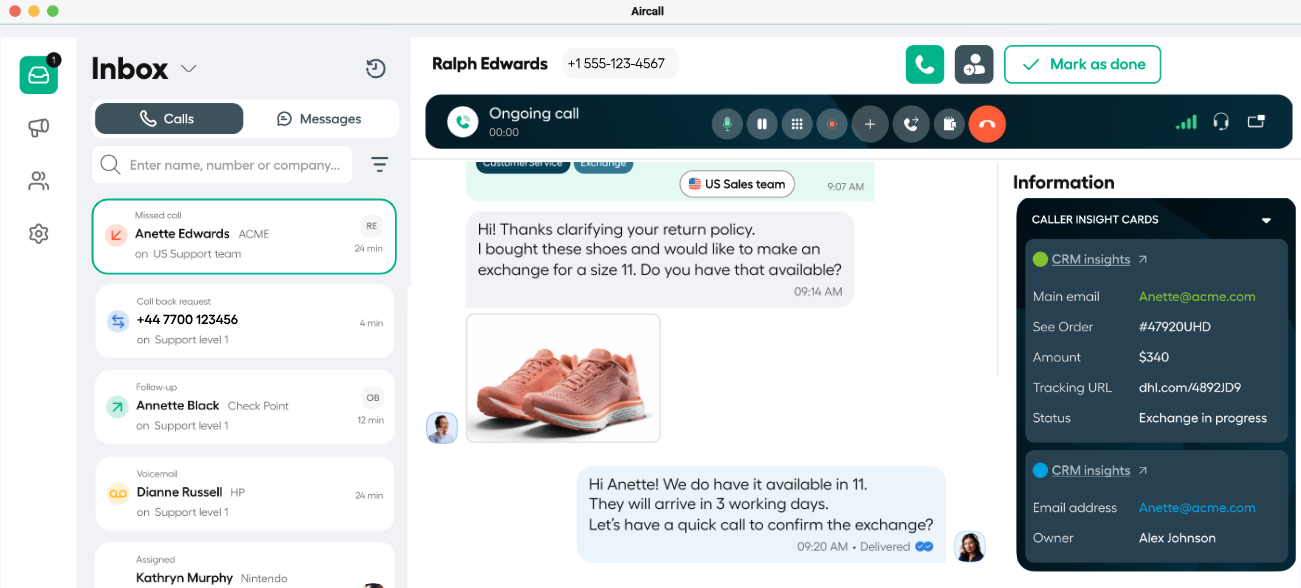
Aircall is an AI Voice Agent that manages inbound calls at scale, captures details, resolves requests, and qualifies leads. It’s a good fit for growing teams that need to handle more volume without hiring more people.
Key Features
- Power dialer and voicemail drop for outbound sales teams
- Smart call routing and IVR
- Call coaching and live call monitoring
- AI voice agent for 24/7 inbound call handling
- Post-call summaries, sentiment analysis, and call scoring via the AI Assist add-on
- International numbers in 100-plus countries
Pros
- Identifies tone, intent, and interruption cues as they happen, delivering contextually relevant responses
- Automatic updates as new AI models are released
- One-click integrations with 200+ CRMs and essential business tools
Cons
- Professional plans require a minimum of three users
- AI features are a paid add-on
Pricing
There are three plans available. Minimum of three licenses on Essentials and Professional, 25 on Custom.
- Essentials ($30/license/month, $90/month minimum): Unlimited calls within the US and Canada, 100-plus integrations, IVR, call recording, click-to-dial, SMS and MMS, and softphone across desktop and mobile. Comes with 50 free AI Voice Agent minutes per month plus 100 bonus minutes at sign-up.
- Professional ($50/license/month, $150/month minimum): Everything in Essentials plus Salesforce CTI, power dialer, voicemail drop, advanced analytics, live monitoring, smart routing, and automated queue callback. AI Assist features are fully included at this tier.
- Custom (custom pricing, 25-license minimum): Everything in Professional plus unlimited worldwide calls, custom onboarding, API developer support, an SLA, and single sign-on.
Vapi
Website: https://vapi.ai/
What It Does / Who It’s For
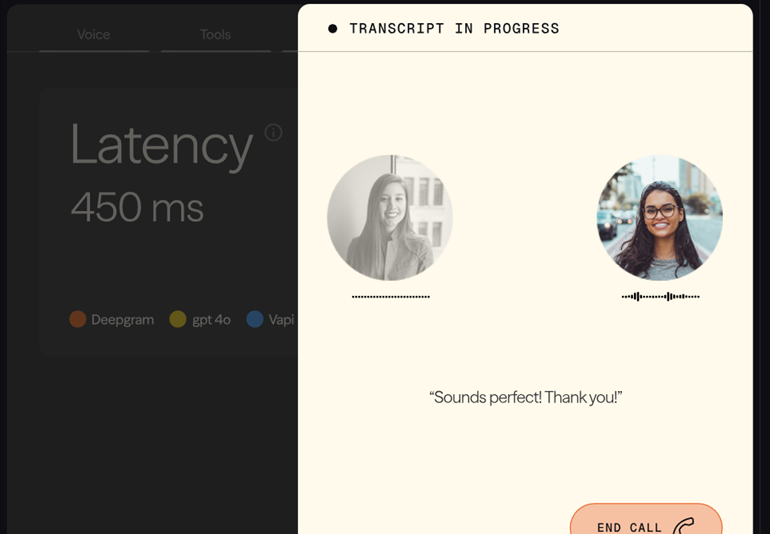
Vapi is a voice AI infrastructure for developers. It gives you the API layer to build, test, and deploy custom voice agents that can handle inbound and outbound calls, book appointments, pull live data mid-call, and integrate into virtually any stack.
Key Features
- Multimodal agents that can switch between voice calls and SMS in the middle of a conversation
- Developer-first platform with abundant API integrations
- Ability to build custom logic flows
- Low latency, with responses in under 500ms for seamless, real-time conversation
Pros
- Human-like voices, and custom pronunciation and transcription keywords
- Boasts 99.99% uptime and enterprise-grade reliability
- Built-in AI conversational guardrails to avoid the “AI hallucination” problem
- SOC2, HIPAA, PCI compliant
Cons
- Requires technical know-how and resources, so non-technical teams might find it complex
- The Pay as You Go pricing plan is usage-based, which means costs can climb fast if you're not watching your minutes
Pricing
Vapi offers two options:
- Pay As You Go: Usage-based, no commitment. Starts with $10 in free credits. Vapi's hosting costs $0.05/min for calls and $0.005/message for SMS and chat. Model provider costs (STT, LLM, TTS) are passed through at cost on top of that. You get 10 concurrent call lines included, then $10 per additional line per month.
- Enterprise: Annual contract, custom pricing. Everything from Pay As You Go plus volume-based hosting rates, custom concurrency, custom data retention, SSO, RBAC, SOC2, HIPAA, a named support engineer, account manager, priority support, and a private Slack channel.
High-Impact Use Cases for AI Voice Agents
We've come a long way from “press 1 for customer support.” The rigid, menu-driven systems of the past have evolved into AI voice agents that handle complex conversations, adapt in real time, and remember context from previous interactions. Today, modern AI voice agents can do much more, so let’s look at some of the high-impact use cases.
Speed-to-Lead Qualification
If your small business is picking up steam and lead qualification is starting to feel like a bottleneck, an AI voice agent can help. It increases speed-to-lead by following up with new leads in seconds, asking the right qualifying questions, and handing your team a warm lead. Close's AI sales teammate Chloe, for example, picks up inbound leads instantly and runs structured qualification — so your reps only spend time on leads that are already warm.
After-Hours Appointment Booking
Small businesses feel the pressure to be available 24/7. But since that's not realistic, AI voice agents are the next best thing. When your team logs off, the AI keeps working, capturing bookings and answering questions so you wake up to a full calendar the next morning.
Inbound Routing and Triage
Instead of hiring more people for manual tasks, you can use AI agents to gather context upfront and route each call to the right person.
The "Handoff" Problem
No matter how advanced, AI still doesn’t have all the answers and, in some cases, requires human assistance. But here’s the thing: when a call needs a human, the AI passes it over with full context already captured, so the rep picks up mid-conversation, not from scratch.
Compliance and Trust
An important topic to consider when testing AI voice agents is compliance. Consent and data privacy are two non-negotiables for AI voice agents.
The Telephone Consumer Protection Act (TCPA) restricts telemarketing calls, SMS texts, and fax messages, requiring prior express written consent for autodialed or prerecorded marketing calls to cell phones and residential lines. In February 2024, the FCC confirmed that the TCPA's restrictions on “artificial or prerecorded voice” apply to AI technologies that generate human voices.
Translation: Before making an outbound AI voice call to a mobile or residential number, you need written consent. Inbound calls (where the customer calls you) carry far less regulatory risk. The TCPA compliance burden is primarily on outbound calling campaigns.
Aside from compliance, data privacy and data security are also crucial when using AI voice agents. What this means: If your voice agent will handle sensitive information, you must ensure your provider meets industry-standard compliance certifications.
Most of the AI voice agents covered in this guide hold the key compliance certifications your business needs. SOC 2 Type 2 sets the benchmark for data security. PCI compliance covers the handling of credit card data. And HIPAA is mandatory for any application that touches protected health information. All of this should be part of your AI purchasing decision.
Integration is the Real Product
An AI voice agent that can't talk to your CRM is just an expensive answering machine. The true power of AI agents isn’t the conversation. It's what happens after it ends. Call logs updated. Lead status changed. Follow-up sequences triggered. That’s how you get ROI.
When evaluating AI voice agents, don't just demo the call quality. Ask how it handles data after the call. Look for native CRM integrations or webhook support that connects your voice agent directly to the rest of your stack. That’s the only way to make a meaningful impact. Otherwise, you’ll be stuck with manual updates.
This is the reason we built Chloe directly into Close rather than as a separate tool. Because she lives inside the CRM, there's no integration to set up, no syncing delay, and no data that lives in a separate dashboard. She logs the full conversation, outcome, and next steps before the call ends — your reps open the lead and everything is already there.
Which is the Best AI Voice Agent for Your Small Business?
The best AI voice agent for your small business isn't necessarily the most powerful. It's the one that fits your team, your stack, and your budget.
If you're non-technical and need something running fast, start with a platform like Synthflow or Retell. If you have engineering resources and want full control, Bland or Vapi will give you more options. And if you're already running a call-heavy sales or support team, Aircall wraps AI into a phone system your reps already know how to use.
One thing to remember: Make sure the AI voice agent connects to your CRM. A voice agent that holds a great conversation and logs nothing is just a very expensive receptionist. You need an AI voice agent that can push call summaries to your CRM, update lead status automatically, and trigger follow-up tasks.
This is especially important for small businesses. You don't have a dedicated ops team cleaning up data or a RevOps function building automations. You need a voice agent that does the heavy lifting — and ideally one that's already inside the system your team runs on.
That's the approach we took with Chloe, Close's AI sales teammate. She calls your leads, qualifies them, books meetings, and logs everything in your CRM automatically. No integration to manage, no new vendor to evaluate. Join the waitlist here.
FAQs about AI Voice Agents for Small Businesses
Is it legal to use AI voice agents for cold calling?
AI voice agents are legal. However, the FCC treats AI-generated voices the same as prerecorded robocalls under the TCPA, meaning you need prior express written consent for outbound cold calling. They are safer and better suited for following up with inbound leads who have opted in.
Can AI voice agents transfer calls to humans?
Yes, this is a critical feature known as "warm transfer." A capable AI agent can detect when a caller is frustrated or asks for a human, place the caller on hold, and hand the call over to a human. Advanced platforms can even pass a summary of the conversation to the rep who picks up the call, giving them more context.
What is the difference between an IVR and an AI voice agent?
An IVR (Interactive Voice Response) is a menu system that requires users to press keys ("Press 1 for Sales") or say specific keywords. An AI voice agent uses Large Language Models (LLMs) to understand full sentences, context, and intent, allowing for a fluid, back-and-forth conversation similar to speaking with a human.
Does the AI voice agent integrate with my calendar?
Most reputable AI voice platforms integrate with major calendar providers like Google Calendar and Outlook, often via tools like Cal.com or Calendly. This allows the agent to read your real-time availability and book slots directly while on the phone with a customer, preventing double bookings.