

AI voice agents promise a seller’s dream: automated outreach that sounds human, scales infinitely, and never calls in sick on a Monday.
However, this raises another question: do you build one yourself or buy one that already exists?
It may sound like a simple procurement decision, but often, it isn't. It really comes down to how you’d address three things: how much engineering risk you're willing to absorb, how fast you need to move, and where your competitive advantage actually lives.
Get those pieces wrong, and you may spend six months building infrastructure instead of closing deals. Let's make sure that doesn't happen.
TL;DR
- Building is harder than it looks: Owning the infrastructure means managing latency, telephony, compliance, and ongoing maintenance.
- Buying is faster: Most sales teams can deploy a bought platform in 5 to 14 days. A custom build takes four to 9 months.
- Compliance is your problem when you build: AI-generated voices are subject to TCPA regulations. If you don't have the legal resources to stay on top of that, let a vendor handle it.
- Most “custom” use cases aren't as unique as teams think: Modern platforms handle scripts, CRM integration, and handoff logic via API.
- Building only makes sense in three scenarios: Voice AI is your core product, your data can't leave your environment, or your internal systems can’t connect to outside platforms.
- The smartest approach is often hybrid: Buy the voice capability, but build the decision-making logic on top of it.
- Your CRM is the deciding factor: A voice agent without access to deal stages, call history, and lead status is just making noise.
The Reality of Building Your Own AI Voice Agent
Most sales leaders who consider building their own AI voice agent are thinking about the demo they saw. Building sounds reasonable after you've seen a good demo with smooth conversation, natural pauses, and instant responses.
Maybe you think, “How hard could it be?”
Pretty hard, it turns out. The demo doesn't show you the infrastructure required to make that experience work reliably.
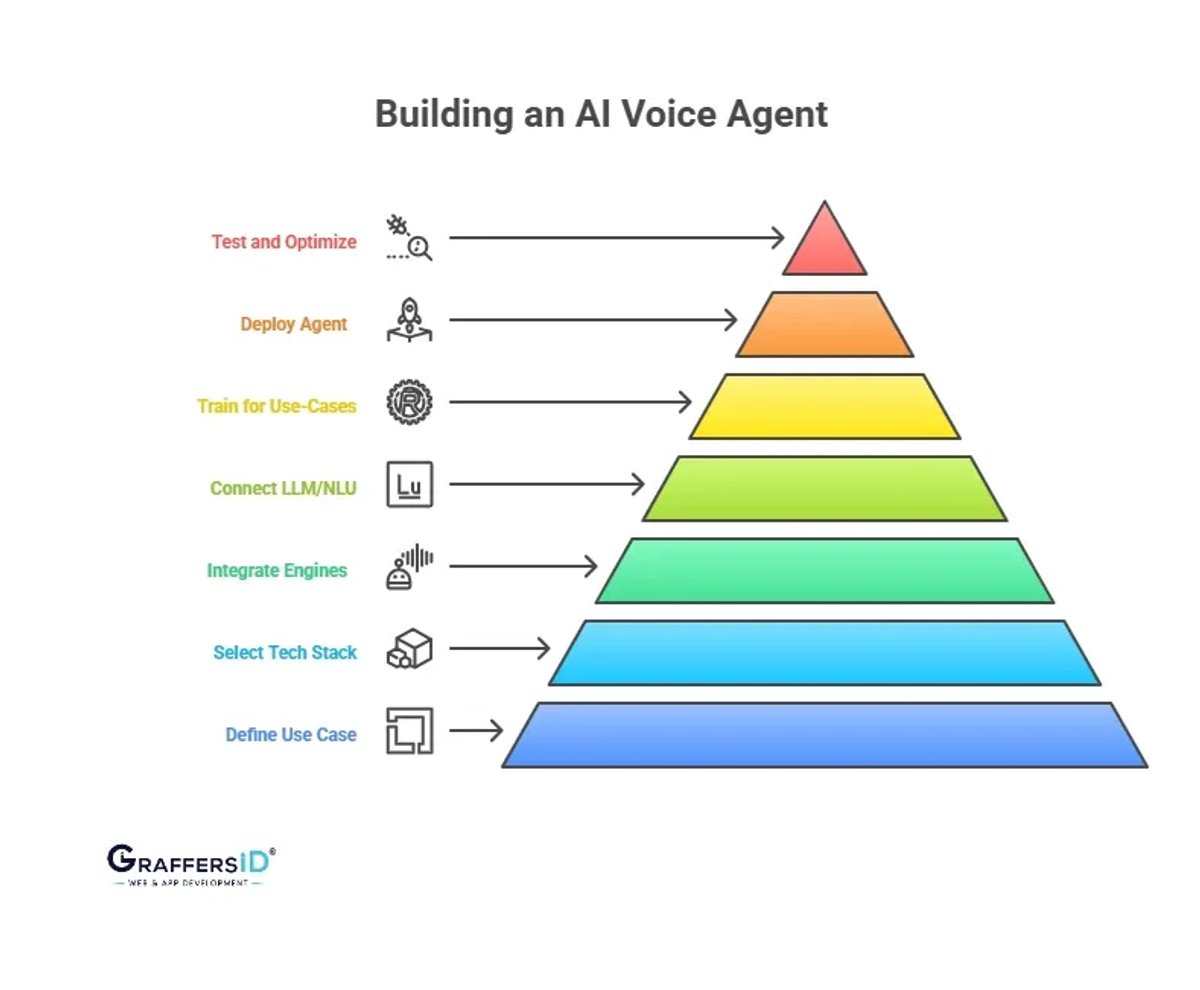
Building a voice agent isn't just connecting an LLM to a microphone. Under the hood, every AI voice response goes through several steps: your words get transcribed, sent to a language model, converted back to speech, and streamed through the call.
All of that has to happen quickly enough that the person on the other end of the line doesn’t notice.
Latency: The Silent Killer of DIY Voice Agents
You know that slight lag on an international call where you accidentally talk over the other person? In voice-agent-speak, that's called latency. And in AI voice, it's where most DIY projects fall short.
Research suggests that interactive voice tasks begin to break down when delays exceed 0.4 seconds, a threshold defined by technical standards for call latency budgets. After 0.5 seconds, callers start talking over the agent. The conversation falls apart.
Translation: If your AI voice agent takes longer than the length of a natural pause in conversation, the interaction starts to feel unnatural. The caller notices the delay, even if they can't explain why, and the conversation loses its natural flow.
Hitting the right latency threshold requires a very specific kind of engineering expertise that most sales-focused teams simply don't have.
The Infrastructure Trap
Latency is just the beginning. You also own everything underneath the voice capability itself: carrier relationships, call routing, recording storage, and ongoing maintenance. When something breaks at 2 am on a Tuesday, that's your team's problem to fix.
For most sales organizations, this is a significant and often underestimated operational burden.
The Case for Buying a Voice Platform
For most sales teams, buying a managed platform is the smarter call. Building isn't impossible, but the economics and timelines rarely make it worth it.
Speed to Market
With a managed platform, you can go from zero to a working voice agent in as little as five to 14 days. Set up your scripts, connect your CRM, and you're live. A custom build that actually handles interruptions, latency, and security takes 4-9 months.
In a competitive sales environment, that gap is enormous. Two weeks in, one team is running thousands of calls. The other is still testing.
And if the voice agent is already built into your CRM, the timeline shrinks even further. Chloe, Close's AI sales teammate, doesn't require any integration or deployment at all — she's already inside the platform your team runs on. Define your qualification criteria, set your tone, and she's live
Shifting Compliance Risk
The regulatory environment for AI voice is strict, and it's only getting stricter. U.S. consumers received 52.5 billion robocalls in 2025, and regulators have taken notice.
The FCC clarified in early 2024 that AI-generated voices are subject to TCPA regulations, including consent and disclosure requirements. Achieving all of this independently means you’ll need significant time and resources to focus on obtaining those, which most sales teams don't have.
Buying a voice platform transfers much of that burden to the vendor.
Great platforms update their systems as regulations change, maintain audit trails for consent management, and hold the required certifications. For high-volume sales teams, the risk transfer alone can justify the price tag.
What “Custom” Really Means
Many teams assume their use case is too unique to justify buying a platform. Most of the time, that's not actually true.
Call scripts, handoff logic, and CRM field mapping are handled by the API of modern platforms. If your advantage is in how you sell (not how the technology works), you likely don't need to build from scratch.
When Building Your Own AI Voice Agent Makes Sense
There are real scenarios where building is the right answer. They're just less common than most teams expect.
Voice AI is your core product: If you're building a product to sell to other companies, the voice capability itself is your competitive moat. Think voice AI platforms, contact center tools, and outbound dialing solutions. In that case, owning the stack makes strategic sense.
Highly proprietary data workflows: Some conversations involve data that simply can't be shared outside your organization. In that case, building gives you full control over your data.
Deep, non-standard integrations. Some internal systems do not have API access. If your voice agent needs to read from and write to one of those systems in real time, a managed platform may not support it. When your data requirements are truly unusual, a custom build gives you options that platforms don't.
Even in these cases, it's worth pressure-testing the assumption. Platforms are rapidly expanding their integration capabilities, and what wasn't possible 18 months ago is now.
The Hybrid Approach: Buy the Engine, Build the Brain
The most effective teams often land somewhere between the two options. Instead of going all-in on one or the other, they buy the voice capability and build the decision-making logic on top of it.
That custom layer is where your sales strategy actually lives. It's the logic that decides which leads get called, when to hand off to a human, and what happens to the data after the call ends.
Deal stages, call history, and lead status all feed into smarter calls. Building that layer on top of a bought platform gives you a real competitive advantage, as your engineering team gets to work on the interesting stuff while the infrastructure is already taken care of.
AI Voice Agent Integration: Why Your CRM Is the Deciding Factor
A voice agent is only as good as the data it can access. If it can’t see a prospect’s deal stage, call history, or open emails, it's going into every conversation blind.
It can handle basic outreach, but it can't adjust its approach based on a lead's funnel stage. And the data it leaves behind after the call won't be much use to your reps, either.
That’s why CRM integration isn’t optional. It's the difference between a voice agent that moves deals forward and one that just makes calls.
This is exactly why we built Chloe directly into Close rather than as a standalone product. Because she lives inside the CRM, Chloe already has access to lead data, conversation history, and deal context from day one. She logs the full conversation, outcome, and next steps before the call ends — no syncing, no separate dashboard, no data that your reps have to go hunt for.
Before you commit to investing in AI voice automation, map out every piece of data your voice agent needs to access during a call. Can your platform reach all of it in real time? If it can't, that's a high cost you didn't factor in. Most teams discover this gap only after they've gone live.
How Close Fits Into This Decision
If you've read this far, the pattern is clear: the biggest risks of building are infrastructure, compliance, and integration. And the biggest risk of buying is ending up with a voice agent that lives outside your CRM and creates more work than it saves.
Close eliminates both sides of that tradeoff. Chloe, our AI sales teammate, is built directly into the CRM — she calls your leads, qualifies them against your criteria, books meetings, and logs the full conversation, outcome, and next steps before the call ends. There's no integration to manage, no syncing delay, and no new vendor to evaluate. If you're already on Close, Chloe is ready when you are.
She's not the only AI capability in the platform, either. Call Assistant automatically transcribes every recorded call, so transcripts, summaries, and lead updates flow into the same workflows your team already uses. The Power Dialer lets you automatically call through large lead lists, with every call logged and every lead followed up on.
And the longer you use it, the smarter it gets. Chloe learns from your deal stages, past conversations, and outcomes, so every call is more informed than the last.
Chloe is free during beta, join the waitlist here, or start a free 14-day trial of Close to see the full platform.
Build or Buy: A Quick Decision Framework
Before finalizing your decision, run through these four questions:
- Is voice AI your product, or just a tool?
If you're a sales team using voice AI to make better calls, it's just a tool. Buy a platform. If you're a company building a voice AI product that other businesses will pay for, then the technology itself is your product. In that case, building makes sense because owning the technology gives you a competitive advantage. - How fast do you need results?
Building a custom voice agent takes 4 to 9 months before it's ready for real customer calls. Buying a platform can get you live in 2 weeks. So the question is simply: how fast do you need results? If you need to move quickly, buy. If you have the time and resources to wait several months for a custom solution, building is realistic. - Who owns compliance?
If you don't have dedicated legal and engineering resources to track TCPA and FCC changes, let a vendor handle it. - Where does your competitive advantage come from? If it's in your sales process rather than the technology, you probably don't need to build.
Ready to skip the build-vs-buy debate entirely? Meet Chloe, the AI sales teammate already built into Close.
Frequently Asked Questions
Still not sure which way to go? These are the questions we hear most often from sales teams weighing the build vs. buy decision.
What does it cost to build vs. buy an AI voice agent?
Building a custom solution typically requires an upfront investment between $150,000 and $500,000 for engineering talent and infrastructure, plus ongoing maintenance. Managed platforms generally cost substantially less for most small to mid-market sales teams.
How long does it take to get up and running?
A managed platform can be configured and be live in 5 to 14 days. A custom build that correctly handles latency, interruptions, and security typically takes 4 to 9 months to reach production-ready status.
What compliance risks should I know about?
The FCC has clarified that AI-generated voices are subject to TCPA regulations, which govern consent requirements and disclosure obligations for artificial voices in sales calls. Your team is responsible for full compliance when you build your own agent. Reputable platforms handle much of this through regular updates and built-in consent management tools.
Can a bought platform handle my custom workflow needs?
In most cases, yes. Modern voice AI platforms expose robust APIs that allow significant customization of call logic, data routing, and CRM integration without requiring you to own the underlying voice infrastructure. True exceptions exist, but they're less common than teams initially assume.