.jpg)

If you’re a founder wearing multiple hats with a never-ending to-do list, you can’t afford to lose more time or money making educated guesses on AI investments that overpromise and underwhelm.
Investments in AI tools aren’t something to be taken lightly, either. Things like AI voice automation aren’t the typical SaaS purchase. The stakes are higher when your AI actually speaks with your customers.
In a perfect world, you’d have bandwidth for leisurely experimentation. But, let’s be real: You need to move quickly.
That’s why this guide is here to help you figure out where to invest some of your most important AI budget before you commit to anything long-term.
TL;DR
- Define your problem first - Identify your specific use case (outbound calls, lead qualification, follow-up automation, or call coaching) before evaluating any tools to avoid expensive purchases that don't match your actual needs.
- Find honest reviews from similar businesses - Skip affiliate content and seek genuine feedback on Reddit, forums, and social media from companies that match your sales motion, team size, and use case to get realistic expectations.
- Calculate true total cost of ownership - Factor in subscription pricing, implementation time, training costs, and rep adoption challenges beyond the base price, and verify compliance with call recording laws in your state.
- Use trials to test real-world performance - Evaluate how the AI handles interruptions, recovers from failures, maintains consistency, and fits into your actual workflows rather than relying on polished demos.
- Assess ongoing effort and integration depth - Check customer support quality, onboarding resources, CRM integration capabilities, and ongoing maintenance requirements to ensure the tool actually saves time rather than creating more work.
How to Clarify the Problem You’re Actually Trying to Solve
Too often, teams start backwards. They focus on the tool instead of the problem.
Maybe you see another founder posting on LinkedIn about how using the latest shiny new AI tool for sales has “been life-changing.” Cue the FOMO. You start thinking, “Do I need that tool too?”
But before you go down that path, define your primary use case, AKA the specific function (or series of functions) through which you can deploy that AI tool today. If you had to do one thing with this AI software, what would it be? What’s the goal?
Let’s think through this in the context of an example. In this scenario, let’s say you’re evaluating an AI voice automation tool.
Your primary use case might be:
- Outbound calls: Voicemail detection, drop capabilities, tracking the call “disposition” or emotional state of the person receiving the calls
- Lead qualification: Quality of natural language understanding, calendar integration for instant booking, CRM mapping to capture lead criteria
- Follow-up automation: Trigger-based calling from CRM events/triggers, context awareness with previous customer interactions, sentiment detection for escalation
- Call coaching/analytics: Accuracy of real-time transcriptions, keyword/topic tagging, side-by-side rep performance comparisons
Different goals = different capabilities and tradeoffs.
Maybe you don’t care about one software’s tradeoff because the side features don’t matter, but you don’t want to be months deep into a new tool only to discover the tradeoff was devastating to your goal.
Performing Research Beyond the Feature Lists
Features lists don’t say what it’s like to use a piece of software. Unless you have endless free time to experiment with different options and find which tools are *actually* great, you’ll probably need to look to recommendations and honest product reviews from people with similar use cases.
So how do you find honest reviews?
- Web forums or social media threads can be helpful because you typically see people speaking openly about which voice AI software best meets their needs. (Think Discord, private Slack or WhatsApp groups, etc.)
- Reddit is helpful, including specific communities like r/SaaS, r/Entrepreneur, or r/ArtificialIntelligence. You can also add “Reddit” to the end of whatever tool you’re Googling to surface what people are saying about it in a public forum like this.
- Word-of-mouth referrals are helpful, particularly if you can post on your personal social media accounts and get responses from peers and colleagues.
Questions to Ask for More Honest AI Tool Reviews:
- “How long did you use this before your team was fully comfortable using it?”
- “What’s one thing you wish you’d known before buying?”
- “How responsive is the support?”
- “Does it handle [my specific use case] well?”
- “What’s the most annoying ongoing maintenance task?
Run a Quick Sanity Check on Social Proof and Testimonials
Forums and social media are great, but a friendly reminder: Don’t trust everyone on the Internet.
Don’t take testimonials at face value. Start asking: “Who’s saying this? Is it someone whose business is similar to mine?”
A few variables to consider as you browse social media, reviews, and testimonials online:
- Your sales motion. Is the person writing the testimonial running inbound, while you run mostly outbound sales? Do they focus on scaling AI, while you simply want to focus on using AI tools to coach your team members? Look for testimonials from people who have the same use case.
- Team/business size. Even a similar use case might not work as well for a smaller team as it does for a large one. Try to get a sense of the testimonial’s business size first.
- Use case. Even if someone matches your overall motion (inbound vs. outbound) and business size (middle-sized company, say), what if they raved about a software because it qualified leads, something that’s not as important to you? The testimonial’s value becomes…incomplete.
If, however, all of the success stories seem to come from companies like yours? Well, that’s your signal: it’s likely a buy.
Compliance, Consent, and Legal Reality Checks
If you’ve made it to this point in the evaluation process, it’s time to take a closer look at the compliance piece of the puzzle. Not every tool lives in a complete regulatory vacuum, so before you get too excited over a demo, you might want to think about reading up on the legal and compliance realities of your tools first.
Some things to consider:
- Recording/consent requirements. If using tools like AI voice assistants that capture calls or conversations, you need to consider whether you live in a one-party or two-party consent state. And who are you calling, and where do they live? And are opt-ins built into the tool?
- Data handling. Double-check that the AI tools you’re looking into anonymize confidential data by default.
- Platform-level controls. Some tools will work with high-volume use. And when they’re designed that way, they can give you some extra requirements you may not need, like redundant sign-ins for your customers. Make sure the use case matches the tool.
You may not answer every regulatory compliance question from reading an online review. But you’d be surprised what you can find with some light digging.
Assessing Your Total Cost of Ownership
It’s tempting to glance at a vendor’s pricing page and call it a day, but basic subscription fees are only a snapshot of the total cost. There’s setup. Ongoing maintenance. Pricing that scales if your organization grows. You may have to monitor the user headcount on your sales team.
If you don’t factor in QA, you may end up ignoring it. Now you’ve got misrouted sales leads or bad data in your CRM. And it’s hard to calculate the cost of that.
- Base subscription vs. usage-based pricing. Are you paying for tokens or a flat fee? Also, look at how they weigh pricing tiers, such as minutes vs. calls vs. users/seats. Some may be less expensive than you think.
- Implementation. Do customers rave about the software but complain about long onboarding and internal setup costs? Maybe it’s more of an enterprise-scale software than something a smaller-scale company can handle.
- Adoption costs with your reps. Will any new training be required? Will your reps push back against what it does, feeling it’s taking over their work? Do you have buy-in with them?
Even if you think you know the lowest-cost option of your favorite vendors, you don’t really know until you’ve assessed the total cost of ownership.
Evaluating Customer Support (Before You Need It)
The simple truth about customer support is that we don’t think about it. Then something breaks, and you realize how desperate you are for it.
That’s why you should add “customer support” to your checklist here. But go a level deeper than whether or not support is merely offered.
- Read the honest reviews. Compare the offer of “24/7 customer support” with how customers actually felt they were treated.
- Look at what customer support channels are available. It doesn’t tell the whole story, but it’s a strong element. If there’s only email support, for example, you may never get the live onboarding help you need.
- Check on response times. A good response time at least puts you in control of your problem.
Remember, You’re Also Buying a Set of Educational Resources
Ideally, implementing AI is simple, intuitive, and quick to deploy. But when it inevitably isn’t, remember that you’re also signing up for a tiny education.
So look through what kind of education they offer.
- Any sort of training?
- A strong knowledge base full of how-to vids and useful content?
- Anything that might speed up onboarding and help you get started?
- An onboarding specialist to help your small(ish) team?
Look for vendors who make it clear. Onboarding, documentation, and even examples of how teams are using the tool. If you can find those online before you sign up, it’s usually a good sign.
The faster your team understands how to use the AI, the more value you get out of voice automation. After all, the idea is to automate it eventually. That doesn’t work until you figure out how all the proverbial knobs and gears work.
AI Buyer’s Guide Checklist
Before You Buy:
What’s next? Here’s a quick checklist you can use based on everything you just read.
AI Buyer's Guide Checklist
Use this checklist to evaluate each AI automation platform you're considering.
As you research and demo different solutions, score each on a 1-5 scale based on how well the vendor performs. A score of 1 means they fall short or you haven't completed that step, while 5 indicates they excel in that area.
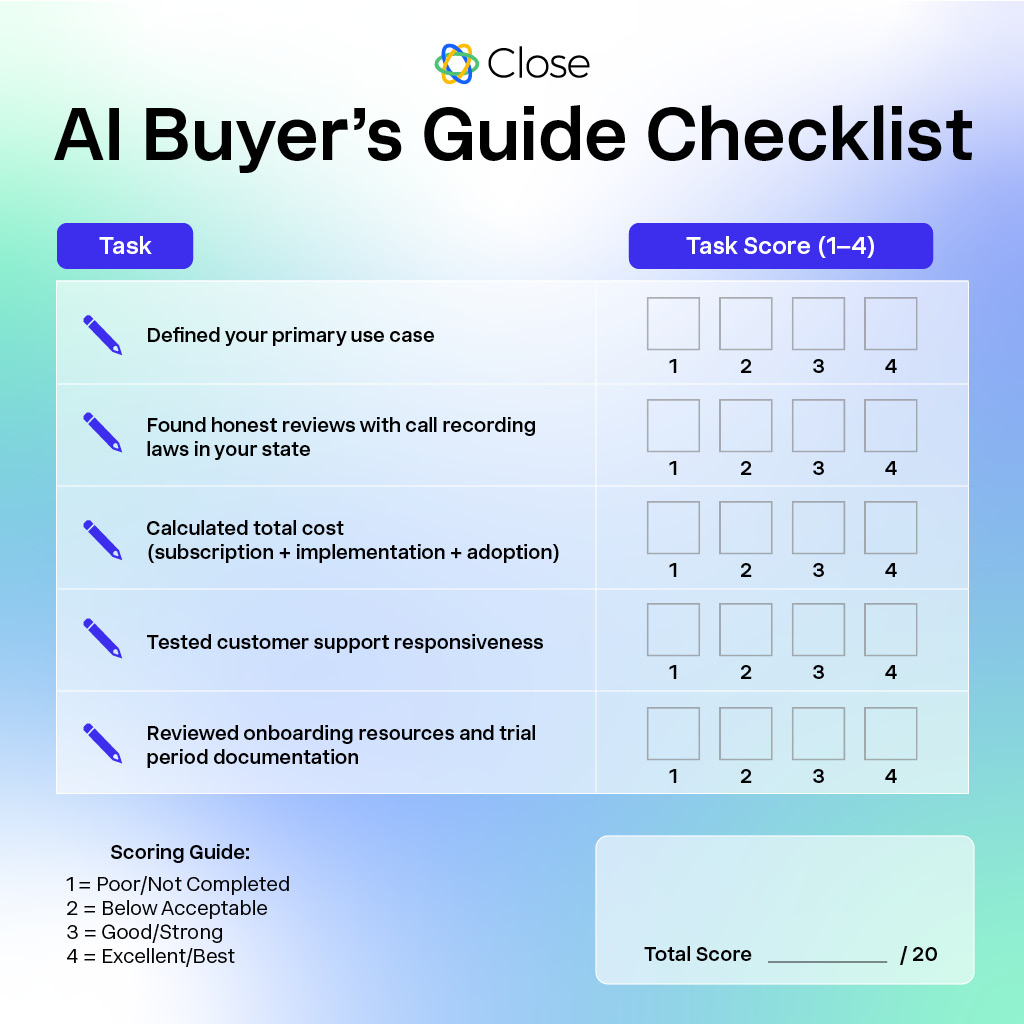
Once you've scored all seven criteria, add up your total. Any platform scoring above 28 points (80%) is likely a strong contender, while anything below 21 points (60%) should raise red flags. Keep a separate checklist for each vendor you evaluate so you can compare them side-by-side and make a data-driven decision rather than relying solely on sales pitches.
Frequently Asked Questions About Investing in AI Tools
Do I really need a trial before buying AI tools?
Yes. Demos look great, but they’re designed to look great. Trials will reveal the friction points you might not otherwise anticipate.
How do I find honest reviews that aren’t affiliate content?
Go where people speak honestly. Reddit communities like r/SaaS and r/Entrepreneur, industry forums like Hacker News, and even your own social networks will be full of honest responses.
How much ongoing work should I expect after setup?
It varies by tool. Expect ongoing tuning, monitoring, and quality control to be a part of it, though. And be willing to ask current users about these issues as you conduct your research.