
Sales communication is evolving fast, and now all the human voices are giving way to AI voice agents that can hold real conversations.
These agents help teams capture missed opportunities and handle some of the more repetitive tasks at scale. So what exactly is an AI voice agent’s role in sales? And how is it different from robotic IVRs and sales dialers?
That’s what this post will unpack. We’ll break down:
- What AI voice agents are and what they can accomplish
- The technical and operational challenges of using them in real life
- Finding a place to fit them into a modern sales process
We’ll also take an honest dip into the trade-offs of these agents and explore where humans can still outperform AI. By the end, you should be able to design a human-led, AI-assisted sales workflow.
Close built Chloe — an AI sales teammate that lives inside your CRM and calls, qualifies, and books leads for you. See how she works.
Key Takeaways:
- AI voice agents are best for scaling repetitive tasks like after-hours coverage, lead qualification, follow-ups, and appointment scheduling—freeing your reps to focus on complex deals and relationship-building.
- Compliance is non-negotiable. You need documented consent for automated calls, proper recording disclosures, and adherence to TCPA, state laws, and industry regulations.
- Technical and UX challenges are real. Expect issues with accents, conversation delays, integration headaches, and the need for constant script refinement based on actual call transcripts.
- Start small and test relentlessly. Begin with low-risk scenarios (like after-hours inbound), integrate with your CRM, monitor performance metrics closely, and use a crawl-walk-run approach before scaling.
- AI augments humans, it doesn't replace them. Use AI for grunt work; keep humans for trust-building, negotiations, and closing. The goal is friction removal, not rep replacement.
What is an AI Voice Agent?
They listen to what your customer needs, respond naturally, and guide them through your sales process without feeling overly robotic.
This takes technology a step above phone menus. AI can “listen” in the sense that it can decode the language of your customer to interpret intent and even answer questions in real-time. This “listening” also helps them accurately guide each caller through your conversation flow.
And, yes, the result is remarkably human. It requires a high-quality mixture of the following, but it all works together to make the process feel organic:
- NLU (Natural Language Understanding) interprets meaning and intent from spoken language.
- Automatic speech recognition (ASR) transcribes spoken language into machine-readable text for processing.
- Speech synthesis converts your system’s responses from text into audio that sounds like a natural speaker.
- Intent management / conversation orchestration can route conversations based on the interpreted responses of your customers.
- Context memory makes sure that your AI doesn’t have the memory of Dory from “Finding Nemo.” That could get frustrating.
Combine these elements, and you’ll see why AI voice sales agents are such a step forward. Consider:
- IVRs (Interactive Voice Response systems) are rule-based phone systems using prerecorded prompts. They mimic sales agents but don't involve any actual decision-making—all they can do is route people without qualifying them as leads or answering their questions.
- Autodialers place outbound calls at scale, potentially connecting answered calls to a live sales rep, usually working from a basic script. They don’t have the ability to respond and learn the way AI voice agents do. Think of them as placeholders.
- AI Voice Agents, on the other hand, adjust dynamically and in the moment. They’ll also interpret based on tone and the caller's intent. They can handle what happens if a customer goes “off script.”
AI voice agents can now have real-time, natural conversations that answers objections and questions instantly. In some cases, it may even overcome objections while maintaining the momentum of sales qualification.
What sets an AI voice sales agent apart? It listens better. It talks better. Think: IVR, but actually helpful.
The obvious advantage of AI voice agents is that they can scale your team. But there are other advantages to more advanced contextual understanding. It can pull data from the key call details and log them into your CRM, turning your sales team into a well-oiled lead-qualifying machine.
And they don’t even have to take coffee breaks.
Types of AI Voice Sales Agents
Not all AI Voice Sales Agents are made alike. Some handle outbound, some handle inbound—and they all have quirks worth parsing through.
Inbound AI voice agents
These are the AI voice agents waiting for a call. A customer—often a warm lead, considering they’re calling you—dials your business’s number and thanks to your AI voice sales agent, immediately gets someone on the line.
Why they matter:
- Preventing missed leads. Imagine having a competent sales agent picking up every call—instantly, and even after work hours. You won't have to give up leads simply because you weren’t there when a lead in Denmark was ready to buy.
- Reducing wait times. Since the AI voice sales agent is always “on,” there are no holds and no lag times as the call gets routed to the right agent.
- Ensuring consistent qualification. Not all phone calls are leads. One person might be trying to sell you on their cleaning service, while the next runs a $50 million revenue company in need of your SaaS. AI voice agents will help you sort through these.
How they work:
- Detecting caller intent from tone and text, while keeping the conversation natural and flowing.
- Collecting and structuring key details you need (like budget/timeline) before passing a lead to the appropriate rep.
- Routing calls based on intent rather than trying to figure out where a customer fits within a predetermined menu tree.
Examples of Inbound AI Voice Agents at work:
- After-hours call capture. What if no reps are available? The AI answers without missing a beat, then logs the lead’s information to your CRM.
- Routing based on interest. Imagine if “Press 1 for sales” no longer goes to voicemail, but instead becomes “Tell me what you’re interested in today.”
- Qualification intake: Need essential numbers like budget, timeline, or revenue expectations? Let voice agents gather them before passing them off to a rep.
- Customer support triage: Feed your AI information about your product to double as a customer-support troubleshooter, or at least make it better at routing the customer to the right rep.
fIf you're a Close customer, this is exactly what Chloe does. She picks up inbound leads instantly, runs structured qualification based on your criteria, books the meeting or routes to a rep, and logs the full conversation in your CRM before the call ends — no integration required.
Outbound AI voice agents
It would be great if all you had to do was answer the phone from an interested customer. But not all sales are like that.
For the more active sales team, an outbound AI voice sales agent is essential for stirring up interest with someone who doesn’t know you yet.
Why they matter:
- Expanding your outbound capacity without hiring an army of new sales reps.
- Following up on time with every warm lead, form fill, or trial user you’ve encountered.
- Keeping messaging consistent in your outreach sequences.
- Freeing up reps from manual dialing and other repetitive outreach tasks you’d rather not do.
How they work:
- Initiating calls, usually working from programmed scripts, but scripts that can now adapt to the live responses of the prospect.
- Delivering follow-up messages, including qualifying questions, based on the CRM data you feed it.
- Scheduling demos or meetings directly within the call, directing outbound leads back to your reps.
- Re-engaging stale leads without making your sales rep cringe with the possibility of “throwing up a prayer” at an old lead.
Examples of how outbound AI voice agents work:
- Automating follow-ups after your form fills—the AI agent can be the one to follow up when someone clicks “send.”
- Dialing people with scripts in either cold or warm outreach, aligned specifically with messaging sequences depending on the status of each call.
- Scheduling appointments, like booking demos and asking what time works for the recipient.
- Re-engaging leads that are still in your CRM who may have expressed interest but had trials that expired.
Hybrid Models
So far, so good. But what if an AI voice agent has to handle both inbound and outbound contexts on the same day? Or even the same conversation? That’s how AI voice agents can start to feel more human: when they’re dynamic enough to work as a hybrid model.
Why they matter:
- Providing flexibility with intelligent switching between your inbound and outbound behaviors, like qualifying leads vs. gauging interest.
- Maintaining conversation continuity across multiple touchpoints.
- Creating a more human-like experience for prospects who are sick of repeating themselves.
- Supporting complex sales processes where leads might interact at multiple touchpoints in different media.
How they work:
- Automatically shifting modes if they receive context cues that prompt the shift.
- Continuing conversations, no matter if AI initiates the call or the prospect calls back.
- Triggering outbound reminders or follow-ups that may need different things, like inbound qualification.
Examples of AI hybrid voice agents at work:
- Imagine AI calls a lead (outbound), but no one picks up. If the lead calls back, AI can switch and continue the conversation (inbound) without missing a beat.
- AI can qualify an inbound call, but then trigger outbound reminders if the lead misses a scheduled task like a booked demo.
Why AI Voice Agents Matter for Your Sales Team
Efficiency Gains and Scalability Benefits
Even if AI agents only took calls, they’d make you more efficient—because they can scale their organic conversations without getting tired:
- AI agents can handle dozens or even hundreds of calls at the same time, which means no waiting time for inbound clients and fewer limits on outbound calls.
- Immediate responses tend to increase your conversion rates thanks to speed and convenience.
- The conversation quality remains consistent. After all, AI doesn’t get cranky if it hasn’t had its morning coffee. No offense.
- Your smaller team can operate like a much larger one without having to hire additional SDRs to handle the grunt work. (This is the thinking behind Chloe, Close's AI sales teammate — early beta teams report she outpaces full teams of human callers on routine qualification.)
When AI Voice Agents Make Sense vs. Human-Only Approaches
AI won’t replace every sales interaction. People still love to talk to people, after all. But AI voice agents are coming for the jobs of autodialers and robotic phone menus thanks to some key advantages.
AI voice agent advantages:
- After-hours availability
- High-volume repetitive qualification
- Scripted objection handling
- Re-engagement or lead nurturing with minimal effort
- Low-complexity product categories
That said, there are some things AI voice agents can’t replace.
Human rep advantages:
- Trust, including the ability to handle large enterprise deals
- Navigating especially emotional or complex customer situations
- Handling novel challenges objections customers pose
- The ability to negotiate
- Multi-stakeholder conversations
ROI Considerations and Realistic Expectations
Given the sophistication of AI voice agents these days, it’s tempting to dump as much money as you can into them. But a more nuanced way to approach it is to look at your existing sales funnels and ask if they’re especially suited for AI voice agents.
There are a few things to consider when setting realistic expectations on ROI:
- ROI depends on volume. AI reduces labor costs, yes. But if you don’t have a lot of labor costs in the first place, then the sophistication of your voice agent is only going to have limited effects.
- If you already have fast speed-to-lead, AI voice agents might give you other advantages, such as 24/7 coverage more consistently.
- AI works best if you already have a controlled workflow. Without one? Failing to give your AI good information and a clear structure might dull the sharper improvements it can make.
- Don’t expect AI to replace SDR creativity, intuition, or the kind of troubleshooting you can do on the phone with a client after years of industry experience.
Common Pitfalls and Hidden Challenges
Technical Challenges
- Accent/language variations. AI isn’t a perfect interpreter. If someone from the South calls you saying, “Ah’m lookin’ fer…” it can easily misread the data and quickly frustrate the customer.
- Solution: Try to find models trained on diverse dialects with quick, convenient clarification prompts that maintain accuracy.
- Latency and conversation flow. As humans, we’re used to quick back-and-forth. Even a 0.75-second conversation delay feels strange to us. It might be enough for some customers to declare, “Well, this is AI,” and hang up.
- Solution: Pre-buffering responses so the most common replies feel instant and natural.
- Complex integrations. People talk a lot about the time you save with AI. If you’re constantly onboarding AI by mapping it to your CRM fields and struggling, you don’t feel like you’re saving much time.
- Solution: In Close, map all CRM fields correctly and validate them before use so that the data syncs correctly.
- Call quality variance. Poor Internet? Carrier issues? Weird electromagnetic effects in the sky? Poor Internet can cause issues like clipping or echo that a human wouldn’t have.
- Solution: Apply adaptive audio processing and network smoothing in your solution. This should reduce any clipping and give you the strong, natural speech you’re after.
User Experience Pitfalls
- Over-automation risks. Ever call a business, try to interact with its phone system, and get frustrated when it felt like working your way through a hamster wheel? Yeah, no one wants that. Sometimes, a caller can keep asking for a human while the AI doesn’t know better but to stick to a programmed script.
- Solution: When the AI flags complexity, make sure you use your CRM Workflows to route tasks to humans ASAP.
- Tone and personality mismatches. AI tends to sound formal, casual, or cheery for some brands. Why would a brand with a fun, casual voice greet callers like it’s in Hour 2 of a shareholders’ meeting?
- Solution: Use transcripts inside Close, which lets you review tone and refine your scripts based on how people are actually chatting.
- Handling objections and edge cases. AI isn’t great with edge cases. It tends to “freeze” or offer unhelpful responses. What if a prospect throws a curveball of a technical question at your AI, which gives a non-answer?
- Solution: Monitor AI call summaries with Close. This way you can identify some of those edge-case objections and update your scripts.
- Transparency, or the “Are you a robot?” question. If you don’t disclose that you’re using AI, it can erode trust.
- Solution: Build scripts with simple, honest, on-brand answers. Don’t evade the fact that you’re using AI. If it’s genuinely helpful, most people won’t mind.
Operational Surprises
- Training data requirements: AI isn’t great at jumping into conversations from scratch. If it’s going to match your brand and tone, it needs examples of real conversations, including real customer calls that map your common phrasing.
- Solution: Use past call recordings and transcripts within your Close CRM and train your prompts using these as context.
- Ongoing maintenance burden: Your scripts can potentially degrade over time. A product might update, making an old script provide outdated information.
- Solution: Conduct weekly transcript reviews in Close so managers can identify these issues as soon as they pop up.
- Performance measurement: How well is the AI performing? You don’t know if you don’t measure. If you don’t track metrics like contact rate and handoff quality, you won’t notice any conversion drops from the switch to AI.
- Solution: Use a CRM like Close and its reporting features and call analytics. This way, you can measure the key metrics: contact rates, conversions, and the quality of the handoffs from AI to real human reps.
- Team resistance: Not everyone’s going to be on board with AI at first. Many may avoid adopting AI because they don’t think it can support them, improve their productivity, or “do a better job.”
- Solution: Give reps access to Close’s AI call summaries. This should demonstrate that AI is just another fancy tool that makes their job easier. It’s not a threat to their existence.
Compliance and Legal Minefield
In the telephone universe, there are rules. And these rules get expensive if you don’t follow them.
The TCPA, or Telephone Consumer Protection Act, doesn’t let you make automated calls without “express written consent” except in case of emergency.
And meeting a sales quota, urgent though it may be, unfortunately, doesn’t qualify as one.
The key is obtaining prior express written consent—this is what makes automated marketing calls possible. This consent is often electronic, so you can store it, since the consent needs to be 1) documented and 2) retrievable.
You can’t use an "artificial or prerecorded” voice as part of this law (as per a 2024 FCC case)—and that means AI voices fall under this category. Penalties might be up to $1,500 per violating call, and state attorneys have some additional enforcement power to prevent you from doing it, so needless to say, get that documented consent.
In 2024, the FCC confirmed
Robocall Regulations
Even if you’re calling someone with their consent, there are rules to follow:
- The FCC TRACED Act increased the penalties for unlawful robocalls to enhance enforcement.
- STIR/SHAKEN rules dictate that Caller ID authentication is mandatory before you place any of these outbound calls, so don’t try to sneak it in under an incorrect name.
- You have to comply with Do Not Call lists, meaning you can’t call those on DNC-listed numbers unless specifically exempt.
- Some states, like Florida, may have additional restrictions where you have to get explicit written consent for all marketing calls and texts made with an automated marketing system.
Recording and Consent Laws
- One-party vs. two-party consent states. A two-party consent requires permission from both parties in a conversation before you’re allowed to record it.
- Required disclosures. People have the right to know when the call’s being recorded, so it’ll have to be included as part of your AI’s routine.
- Data retention. You wouldn’t want to leave the recordings out in public. They’re still private, so store them securely.
- GDPR implications. Any EU data needs explicit consent before you process it, such as reviewing call transcripts to see what customer sentiment is looking like.
Industry-Specific Regulations
- Healthcare (HIPAA / Health Insurance Portability and Accountability Act): any patient health information, known as PHI, has to be securely stored and kept confidential.
- FINRA and financial services: These typically stick to the FCC guidance, including time-of-day and consent restrictions.
- Insurance: These rules tend to vary state-by-state, but if there are any specific licensing rules that prohibit outreach in your industry, then, needless to say, you’ll want to know before a violation.
Emerging Legal Gray Areas
AI is relatively new, so the legislation governing its use remains a little gray in some cases.
In some jurisdictions, you may have to identify as AI for callers. Additionally, deepfake and voice-cloning bans may impact what you actually use for the speech synthesis.
Most importantly: be careful about what your AI might claim. If you don’t give your AI specific instructions about what it can and can’t say, your company can still be liable for inaccurate claims and promises.
Best Practices for Implementation
AI isn’t as scary as it seems. It’s a tool, and like any other tool, it takes a little practice to get right. Here are our best practices to make sure your AI voice agent gives you the results you want:
Strategic Planning Phase
Our recommendation: get specific here. What KPIs will indicate how well your AI is performing? Conversion rates? Speed-to-response? What most moves the needle for your sales team?
Start by defining your use cases. “I want to experiment with AI” is too vague. What can you specifically do with an AI voice agent? Link up with other tools, like your CRM, to get specific.
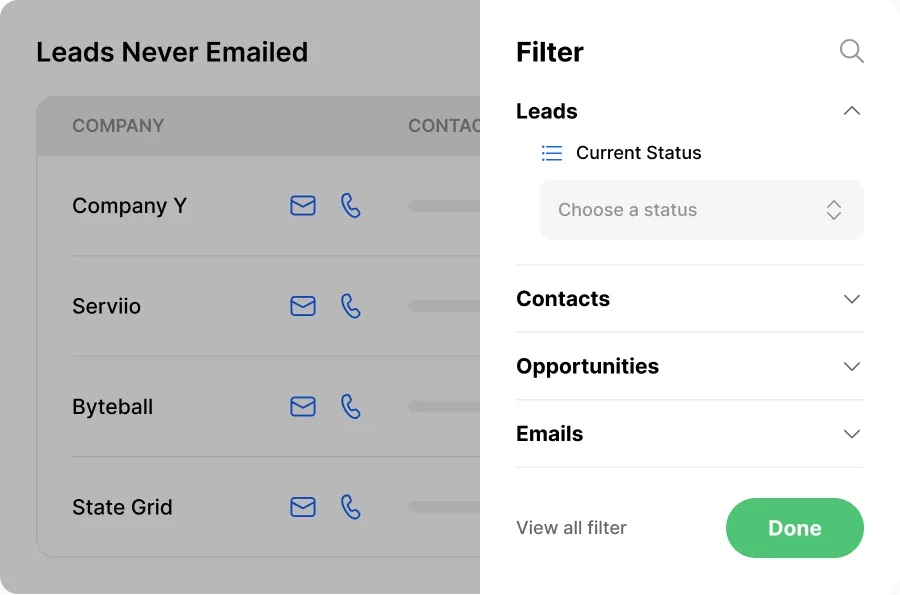
- Maybe you can use Close Pipelines to determine where an AI handoff should occur
- Use Smart Views to group the leads that should and shouldn’t receive any AI outreach
Start small, too. You can try using AI voice agents for low-risk inbound qualification or scheduling.
Technology Selection & Setup
Depending on your brand, you might have different criteria for evaluating AI voice agents:
- Price
- Voice quality/personality
- Preference for outbound vs. inbound vs. hybrid
More specifically, you’ll want to make sure you select the tech you can actually integrate with. It’s not a helpful robot if it stays in “off” mode all the time.
If you're using Close CRM, you already have a head start. Chloe, Close's AI sales teammate, is built directly into the platform — no integration or API work required. She uses your existing CRM data from day one and gets smarter from your leads, conversations, and outcomes over time. You can also use Close's native calling and call recording for training data, and sync fields through Close Integrations or API to align with your workflows.
Finally, how does it “sound”? Not just in terms of audio, but the voice of the AI’s “personality” itself? Do you need to work on scripts? Is it too formal? Too casual?
How the AI voice agent performs right away isn’t necessarily indicative of how it will always perform after you’ve developed specific prompts and scripts, but you should work with a tool that has some baseline agreement with your brand.
Compliance-First Approach
None of this works if you don’t comply with Federal, state, and European laws. So take a “compliance-first” approach:
- Consent management means you’re only conducting outbound marketing calls to people who have given you express written permission—permission you can document digitally
- Find ways to suppress specific phone numbers using Close Smart Views to build suppression workflows. Use your Workflows to automate the post-call compliance steps, like opt-out tagging as well.
- Make sure your AI provides all the required disclosures as part of every script.
- Conduct routine tests and audits to make sure you’re complying.
Conversation Design Excellence
AI is never “done.”
If you want AI voice agents to give the impression of natural dialogue flow, it’s going to take some practice. And AI only works as well as the information you feed it.
That means using transcripts within Close—like successful sales in the past—to refine your current scripts. And you can use Close’s call notes and summaries for ongoing coaching.
Prepare for a few special modes, as well:
- Escalations. What happens when someone keeps saying they want a human? What will the AI say, and to whom will it direct the call?
- Handling the “Are you a robot?” script. Remembering the regulations above, script the AI to be honest and forthright, if always on-brand.
- Failure modes. Give your AI an “out” to admit when it doesn’t know something, rather than giving frustrating recommendations that lead nowhere. And then make sure there’s a workflow to hand it off to an SDR.
Testing and Optimization
Like most marketing tools, you can A/B test AI voice agents. Use Close Reporting and Call Analytics to weigh different scripts against each other. It takes extra work, but you’ll end up optimizing your scripts in a way that ends up delighting customers.
Consider scheduling weekly or monthly optimization routines. Include bias monitoring: is your AI exhibiting any unfair patterns or even outright discrimination? You’ll have to change that.
And even if it’s performing well, there’s always room to optimize if you have further suggestions from your sales team.
Team Enablement
The fastest way to get your team on board is fast onboarding. It sounds circular, we know.
But we mean it. If you can demonstrate the efficacy of AI voice agents quickly, you’ll likely encounter far less resistance from your team—they’ll see it’s just a handy-dandy tool.
Use Close Call Summaries for faster rep onboarding. Show your team how you can assign a task automatically via Workflows, ensuring that no one is left out of the loop. Explore what your handoff protocols will be, too—which helps sales reps understand the new strategy.
You’ll also want to consult with your sales team on what tasks work best with humans, and what you can outsource to AI. Ideally, you’ll get the most ROI from outsourcing the “grunt” work that humans don’t want to do anyway.
Real-World Success Framework
We like the crawl-walk-run framework here. It’s not a race. If you can get AI working for you—even doing something small—you’re already ahead of the curve.
To crawl:
- Start with inbound after-hours AI coverage. This is when you weren't using personal reps anyway, so what is there to lose? If you're on Close, Chloe can handle this out of the box — define your qualification criteria and let her run.
- Use AI only for information capturing and basic qualification at first—then you can hand off inbound leads to real reps.
To walk:
- Maybe now you consider outbound follow-ups. Work on the scripts and test them out before going live.
- Integrate with Close Workflows once you’re sure you have a script, and you’re ready to automate the next steps.
To run:
- Handle multi-branch outbound conversations now.
- Get more sophisticated with the workflows, running full AI-human hybrid routing based on the CRM fields you deem most relevant.
- Run weekly reviews of your transcripts to maintain ongoing quality: remember, AI is never “done.”
The Future of AI Voice Agents in Sales
Emerging Capabilities
AI is an emerging technology. Expect it to get better. Expect it to become more subtle, more human, and maybe even replace a few other jobs your sales reps don’t want to do.
But what does that mean in specific terms? Here are a few upcoming AI voice features to watch for:
- Emotion detection helps adjust AI tone to correspond to customer sentiment, or it can better hand off to a human when it properly reads a caller’s frustration.
- Real-time coaching can augment your reps with live guidance during calls, improving their messaging and ability to handle objections on the fly.
- Multi-language switching should become more sophisticated, making your sales team capable of multi-lingual support, even if it wasn’t necessarily in the past.
- Intent prediction will get more accuracy, anticipating what the caller is going to ask for next based on their previous conversations.
- Automatic objection categorizations will help teams quickly spot the patterns and then improve each script to handle the most common ones.
Integration with Other AI Tools in the Sales Stack
- Emailing sequencing and personalization tools will allow you to trigger personalized follow-up emails after an AI-led call. The AI can handle the personalization necessary, and the email can hit on the right messaging to boost conversion.
- Meeting schedulers can automatically book demos or calls without any manual coordination—just designate a time when you’re free.
- Data enrichment platforms can help you build more specific and helpful lead profiles, getting into the nitty-gritty of firmographic and behavioral data, even during the call.
- AI transcription and summarization inside Close will provide your reps with instant call summaries and context, which speeds up your ability to make handoffs.
Preparing for Regulatory Changes
Again, AI is an emerging technology. Expect it to get more regulated, too. Specifically:
- Mandatory AI disclosure is necessary not only to adhere to the regulations, but to build trust with the people who might be your customers.
- Stricter caller ID rules will reduce call blocking and protect your brand credibility, especially with carriers getting tighter with their standards of verification.
- Regulations around voice cloning will keep ethical voice usage at the forefront, especially as synthetic voice technology gets eerily good at replicating famous voices.
- Clearer liability frameworks will give you a better idea of the risk boundaries and what you’re accountable for when AI makes a claim.
Bringing AI Into Your Sales Process the Right Way
AI voice agents will take a lot of the weight off your reps’ shoulders, true. But with poor onboarding or ignoring the regulations, it can also create a lot more hassle than you need.
The key is to build some nice guardrails not only for the AI, but around your implementation process:
- Technical hiccups in the AI can disrupt the flow of the call
- Overcome by: Building controlled workflows within your CRM, including steady transcript reviews so your AI knows what to do with each call.
- UX friction that frustrates prospects
- Overcome by: Providing a clean handoff plan and path for real humans, continually refining scripts based on what you see in previous calls.
- Operational gaps that appear once AI enters your workflow
- Overcome by: Leaning on Close’s reporting and Workflows to keep everything organized and, just as importantly, readily visible.
- Compliance pitfalls that could potentially cost you a lot in regulatory penalties and fines
- Overcome by: Obtaining and documenting explicit consent, maintaining a reliable suppression list so you know who not to call, and treating AI voice as a tool subject to the same regulations as prerecorded outbound calls.
- Costs that can increase quickly if you don’t set clear boundaries
- Overcome by: Keeping your first few workflows narrow enough to test for impact before you scale them upward and outward in your organization.
FAQ: AI Voice Agents in Sales
What's the difference between an AI voice agent and a regular phone system?
Traditional IVR systems use prerecorded menus and can only route calls based on button presses. AI voice agents actually understand what callers are saying, interpret their intent, respond naturally in real-time, and adapt the conversation based on context, like talking to a human, not navigating a phone tree.
Do I need consent to use AI voice agents for outbound calls?
Yes, absolutely. Under the TCPA, you need "prior express written consent" before making automated marketing calls. This consent must be documented and retrievable. Violations can cost up to $1,500 per call, so compliance isn't optional; it's critical.
Can AI voice agents replace my SDRs?
Not entirely. AI excels at high-volume repetitive tasks like qualification, follow-ups, and scheduling. But humans still win at building trust, handling complex objections, negotiating deals, and managing enterprise sales. Think of AI as handling the grunt work so your reps can focus on what actually closes deals.
How much does it cost to implement AI voice agents?
Costs vary widely depending on call volume, feature complexity, and the platform you choose. ROI depends heavily on your current volume: if you're already handling hundreds of calls monthly, the labor cost savings add up quickly. Start small with targeted use cases to test impact before scaling up.
How do I know if my AI voice agent is actually working?
Track metrics like contact rates, conversion rates from AI-qualified leads, handoff quality to human reps, and customer satisfaction scores. Use your CRM's reporting features to monitor call analytics, review transcripts regularly, and A/B test different scripts. Weekly transcript reviews help catch issues early.
Should I use AI for inbound calls, outbound calls, or both?
Start with inbound after-hours coverage, as it's low-risk since you weren't staffing those hours anyway. Once that's dialed in, add outbound follow-ups for warm leads. Hybrid models that handle both are most powerful but require more sophisticated setup. Match your approach to your team's bandwidth and risk tolerance.
What happens when the AI can't handle a question?
This is where your escalation protocols matter. Design scripts with clear "failure modes" where the AI admits it doesn't know something and immediately routes to a human rep. Use your CRM workflows to trigger these handoffs seamlessly. Transparency here builds trust rather than frustrating callers.
How long does it take to get AI voice agents up and running?
For a basic implementation (simple inbound qualification or scheduling), you might be live in 2-4 weeks. More complex setups with custom integrations, extensive script development, and compliance workflows can take 2-3 months. The key is starting with a narrow use case, testing thoroughly, then expanding gradually.